THE GREAT ABBOT of the Pskov Caves Monastery Father Alipius used to describe himself as follows: “I am a Soviet archimandrite.” And he would eagerly confirm this statement in word and deed.
At the beginning of the 1960s various members of a provincial Party commission visited the monastery with one goal-to figure out some way to close down our monastery. As they inspected the monastery, they saw pilgrims fixing the hedges and the flower beds, and immediately complained to Father Alipius: “How is it that these people are working here illegally?”
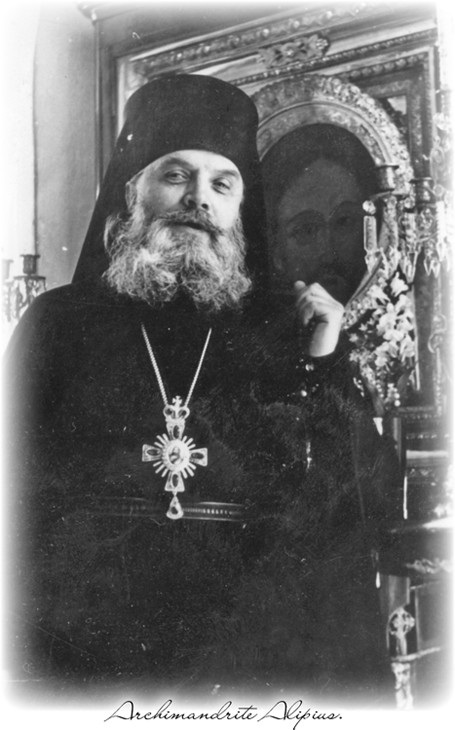
The Soviet archimandrite answered calmly: “They’re not working illegally. These are the people laboring to improve their own Fatherland!”
No further questions were asked. But then another commission was sent from Pskov, this time a financial commission called “the Commission of Popular Oversight”-also with just one goal: to find something wrong and close down the monastery. The abbot asked the delegation to present its letters of authority.
“We represent a financial organ which-“
But Father Aliplus interrupted them. “I have only one overseer, the Bishop of Pskov, Bishop John. Go see him and get his authorization. Without his signature I have no right to show you any financial documents.”
The inspectors left, but naturally several hours later the Bishop of Pskov was calling Father Aliplus, all in a tizzy, and asking that he allow the inspectors to review his documents.
“Your Grace, as a bishop you know that I cannot enter a telephone call into a file. I need that authorization in writing. Please send me a telegram.”
Soon enough the telegram arrived. When the Commission of Popular Oversight inspectors came back, the abbot was waiting for them with the telegram in his hand.
“Tell me, please, are you fellows real Communists?”
“Yes. We are almost all members of the Communist Party.”
“And yet you sought out the blessing of the Bishop of Pskov? Just a moment. I think I’d better send a copy of this telegram to the Provincial Communist Party Committee.”
That was the end of the financial inspection of the monastery.
Before Archimandrite Alipius had taken his monastic vows, his name was Ivan Mikhailovich Voronov. He fought for four years as a soldier on the front lines in World War II, and endured and marched together with the Red Army all the way from the Battle of Moscow to the Battle of Berlin. After that he defended the Pskov Caves Monastery for thirteen years-this time struggling against the very same state for which he had previously spilled his blood.
In both wars Father Alipius truly was involved in a life and death struggle. The then-head of the Central Committee of the Communist Party, Nikita Khrushchev, very much needed a great victory against the Church-no less a victory than the one his predecessor whose glory he greatly envied had presided over in World War II. In order to celebrate his planned-for triumph, Khrushchev aimed for the extinction of the Russian Orthodox Church, which had been in existence for 1,000 years, and therefore he declared war on it, solemnly declaring to the entire world that soon he would show the very last Russian Orthodox priest on television.
Soon thousands of cathedrals and churches were blown up, closed, and converted into warehouses, taxi garages, and tractor factories. The majority of the seminaries and higher ecclesiastical academies were closed. Virtually all the monasteries were dissolved. Quite a few priests were arrested and put in jail. In the entire territory of Russia only two monasteries were allowed to exist: the Holy Trinity Monastery (needed for window dressing in order to show foreign tourists that the Russian Church was still fine, as a sort of Russian Orthodox “reservation”), and one provincial monastery-the Pskov Caves Monastery. It was here that the Great Abbot struggled against the entire machinery of the mighty atheist state. And- most wonderfully of all-he triumphed!
In those days the entire sorely persecuted Russian Church watched with bated breath, waiting to see how the unequal struggle would turn out. News from Pechory was passed by word of mouth, and it was only many years later that the participants in and witnesses of those events wrote down their memories. Here are just a few recollections of those now long-gone struggles.
One winter evening several men in plain clothes marched into the office of Father Alipius and handed him an official command: the Pechory Monastery near Pskov was officially closed. The abbot was hereby commanded to so inform the personnel of the monastery. Having read the document, Father Alipius tossed the paper into a blazing fire right before the very eyes of these officers.
To the astonishment of his visitors he calmly declared: “I am willing to undergo martyrdom and death by torture if it comes to that, but I will never close the monastery.”
The paper that he had just cast into the fire was an official decree of the government of the USSR, and had been signed by Nikita Khrushchev himself. This incident has been recorded by a witness, that most loyal disciple of the Great Abbot, Archimandrite Nathaniel.
I personally never met Father Alipius, as he was no longer alive when I first came to the monastery. However, it is impossible to speak about the Pechory Monastery without saying a few words about him.
Ref: Everyday saints and other stories, p. 255-9

 The Art of Orthodoxy